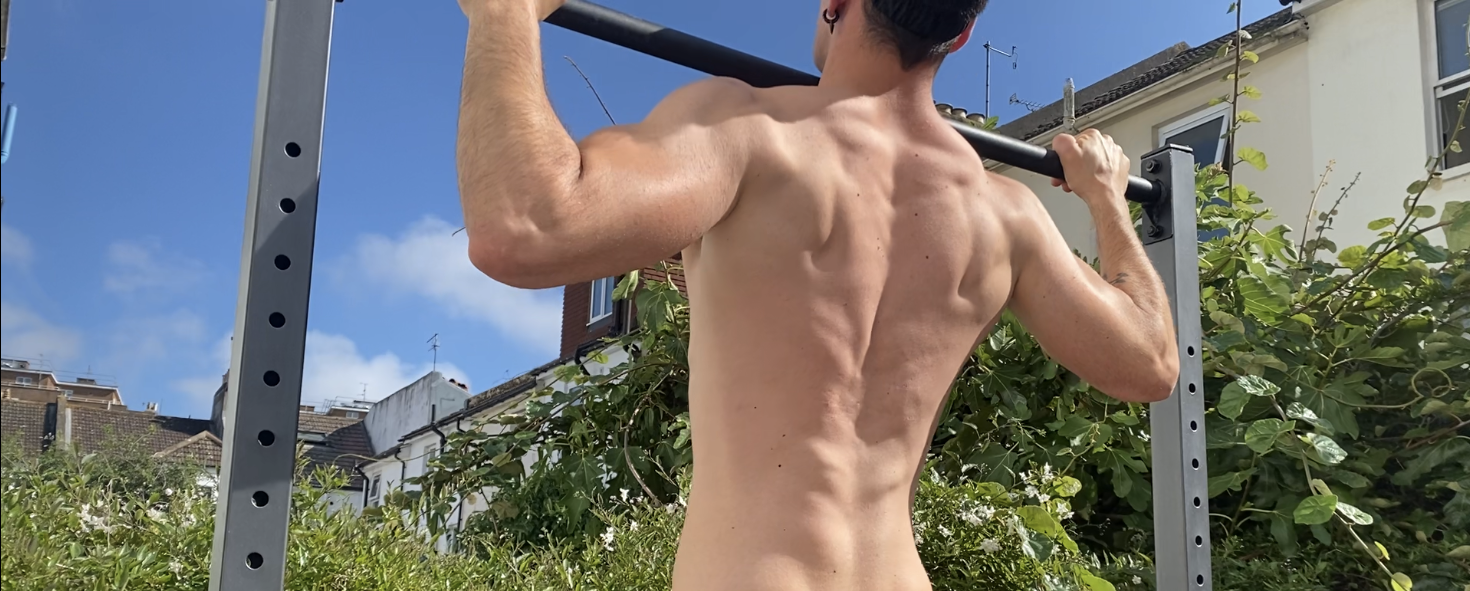
Pull Ups video
Recently, I uploaded a YouTube video where I shared a few thoughts on how to achieve 30 pull-ups in a row. Unfortunately, my video editing skills are still not up to standard, and I encountered many problems with the audio. It looked like I was recording from a cavern.
So I thought it was a good idea to blog it.
I don't normally train specifically for pull-up endurance. In fact, the last time I tested my maximum number of consecutive pull-ups was many years ago. Most of my pulling workouts are focused on weighted pull-ups and one-arm pull-ups, which means that the majority of my training is aimed at developing maximal strength rather than high-repetition endurance.
So, at the end of one of my workouts, I decided to test my pull-up endurance and see how much of that maximal strength would transfer to a completely different goal: performing as many bodyweight pull-ups as possible in a single set.
The result was... acceptable.
I managed 30 repetitions in a row, despite my technique being far from perfect.
During the first 5–10 repetitions, my chin was only just clearing the bar on some reps. During the final 10, fatigue became much more noticeable, and I progressively lost control of scapular depression.
Still, considering that I hadn't specifically trained for high-repetition pull-ups, being able to reach 30 was an interesting result.
And it raises a useful question:
How much does maximal strength actually contribute to pull-up endurance?
There is an obvious relationship between strength and muscular endurance, particularly when we're talking about relatively short-duration strength endurance. This is certainly nothing new.
However, being strong and being able to perform a large number of pull-ups are not the same thing.
If your specific goal is to increase your maximum number of consecutive pull-ups, I think two main factors need to be considered:
PERIODIZATION
Periodization refers to the planned manipulation of training variables such as volume, intensity, frequency, and exercise selection over time to improve performance while managing fatigue and reducing the risk of overtraining.
And yes, even if the goal is simply to increase your maximum number of pull-ups, I would still periodize the training.
From my point of view, doing more and more pull-ups every week isn't necessarily the best way to reach 30 repetitions ( you’ll reach a plateau at some point). Instead, I would divide the training into different phases, each with a specific focus and purpose.
A quick note before we start: this article is not a case study or an individual training prescription. It provides general advice on improving your pull-ups and doesn't account for factors such as your training experience, current strength level, recovery, injury history, or individual goals.
For this reason, the approach discussed below may not suit everyone. If you're unsure about how to structure your training, speak with a qualified coach or trainer who can help you choose an approach based on your individual needs and goals.
A simple three-phase approach
In the case of pull-ups, I would opt for a relatively simple periodisation approach consisting of three main blocks:
1. C&E — Check & Exploration
2. Maximal Strength
3. Specific Endurance
Let's look at each phase in a little more detail.
1. C&E — Check & Exploration
Personally, I would start by running a few basic assessments and identifying anything that could potentially limit the pull-up.
If there is a mobility restriction, a noticeable strength imbalance, or a lack of control (for example, one shoulder consistently depressing more than the other ), I would address this first.
Depending on the individual, this phase could be relatively short or last considerably longer. Not every asymmetry necessarily needs to be “fixed”, and some limitations may also be influenced by individual anatomy. The important thing is to understand whether something is actually affecting the movement before trying to correct it.
If there are no major limitations, we can start developing the muscles involved in the pull-up, including the lats, biceps, traps, rhomboids, and other muscles responsible for controlling the scapula, paying particular attention to any obvious weaknesses.
At the same time, this is an opportunity to become more confident and technically consistent with the pull-up itself.
This period is also useful for gradually exposing the joints, tendons, and connective tissues to the demands of pulling. These tissues generally adapt differently and often more slowly than muscle, which is another reason why suddenly increasing pull-up volume isn't always a great idea.
2. Maximal Strength
The second phase would focus on increasing maximal strength.
This is where weighted pull-ups become particularly useful. A weighted belt and some additional weight allow us to progressively increase the intensity of the exercise rather than simply adding more and more repetitions.
Why work on maximal strength when our eventual goal is 30 pull-ups?
Because increasing your maximal strength effectively makes each bodyweight repetition relatively easier.
For example, in my case, at a bodyweight of around 70 kg, I can perform a pull-up with approximately 60 kg of additional weight. Despite not specifically training pull-up endurance, I was still able to perform 30 consecutive bodyweight pull-ups.
Of course, one example doesn't prove that maximal strength alone will give you 30 pull-ups. But it illustrates the potential transfer that a strong maximal-strength base can provide.
During this phase, most of the work would be performed with relatively high intensities and low-to-moderate repetitions. Personally, I wouldn't spend much time regularly testing true 1RMs. Most sets should still leave some repetitions in reserve rather than being taken to failure.
This allows us to develop strength while keeping fatigue manageable.
However, maximal strength alone isn't enough.
A set of very heavy weighted pull-ups and a set of 30 bodyweight pull-ups place very different demands on the body. The contribution of our different energy systems changes as the duration of the set increases, and our ability to maintain force and technique under fatigue becomes increasingly important.
This is why, during this phase, I would also consider including some practice dedicated to high-repetition pull-up technique.
The most efficient technique for a very heavy single isn't necessarily the same strategy you would use when trying to perform 30 repetitions in a row.
I'll come back to this in the technique section.
3. Specific Endurance
Now we need to make the training much more specific.
The goal of this phase is to take the strength we've developed and improve our ability to repeatedly produce force over a longer set.
In other words, we are moving from maximal-strength development towards strength endurance and power endurance.
Specificity becomes increasingly important here.
We need to practise higher repetitions, learn how to manage fatigue, and develop a technique that allows us to perform each repetition as efficiently as possible.
There are many ways to develop pull-up endurance, and not every method will be equally useful depending on your current level.
We could use methods such as submaximal volume, density work, EMOMs, clusters, or AMRAPs (As Many Repetitions As Possible).
However, simply doing an AMRAP every session isn't necessarily the answer. An AMRAP is a tool, and how we use it within the overall programme matters more than the method itself.
As we get closer to our goal, the training should progressively start to resemble the performance we're preparing for:
30 consecutive pull-ups.
TECHNIQUE
As I mentioned earlier, technique becomes increasingly important when the goal is to maximise the number of pull-ups you can perform in a single set.
If you watch athletes performing 30, 40 or even 50 pull-ups in a row, one thing you may notice is that many of them use a relatively wide grip.
Why?
One possible advantage is range of motion.
With a wider grip, the vertical distance the body needs to travel can be slightly reduced compared with a conventional shoulder-width pull-up. When you're performing only a few repetitions, this difference might not seem particularly important. But when you're trying to perform 30+ repetitions, even small improvements in efficiency can start to matter.
However, ROM isn't the only consideration.
Trajectory and control
When performing high-repetition pull-ups, we don't want every repetition to be deliberately slow. Instead, we want to produce force quickly and complete each repetition efficiently while maintaining enough control over the movement.
This is where power endurance becomes relevant: the ability to repeatedly produce relatively high levels of force despite accumulating fatigue.
If we perform a conventional pull-up explosively, the body's trajectory isn't always perfectly vertical. Depending on the athlete's technique and anatomy, the body can move slightly backwards and forwards around the bar.
As repetitions accumulate, this movement can become more pronounced.
More unnecessary movement means more energy spent.
And when the objective is maximal repetitions, wasting energy is exactly what we want to avoid.
A wider grip can change this trajectory and, for some athletes, create a movement that feels more direct and easier to repeat at speed.
This doesn't mean that the wider the grip, the better.
An excessively wide grip comes with its own disadvantages. It changes the mechanics of the movement, reduces the contribution of elbow flexion, and can simply feel weaker or less comfortable depending on the individual.
This is why I wouldn't suddenly switch to an extremely wide grip just because your goal is to perform more pull-ups.
Instead, experiment with grip width and find the position that gives you the best compromise between ROM, strength, speed, and control.
And this brings us back to periodisation.
If you decide that a wider grip is more efficient for your high-repetition technique, don't wait until the final endurance phase to start using it. Introduce it earlier in the programme, practise it, and gradually become stronger and more confident with that specific movement.
By the time you start your specific endurance work, the technique itself should already feel familiar.
Pull-ups: simple, but incredibly complex
The pull-up looks like an incredibly simple exercise: hang from a bar and pull yourself up.
But once you start looking at strength, grip width, scapular movement, trajectory, speed, fatigue, and efficiency, you realise how much there is to explore.
That's one of the reasons why I consider the pull-up the king of upper-body exercises.
And it's definitely a movement I'll come back to in future articles.
Thanks for reading.